J-1 Change of Status: USCIS Applications and Two-Year Rule Limits
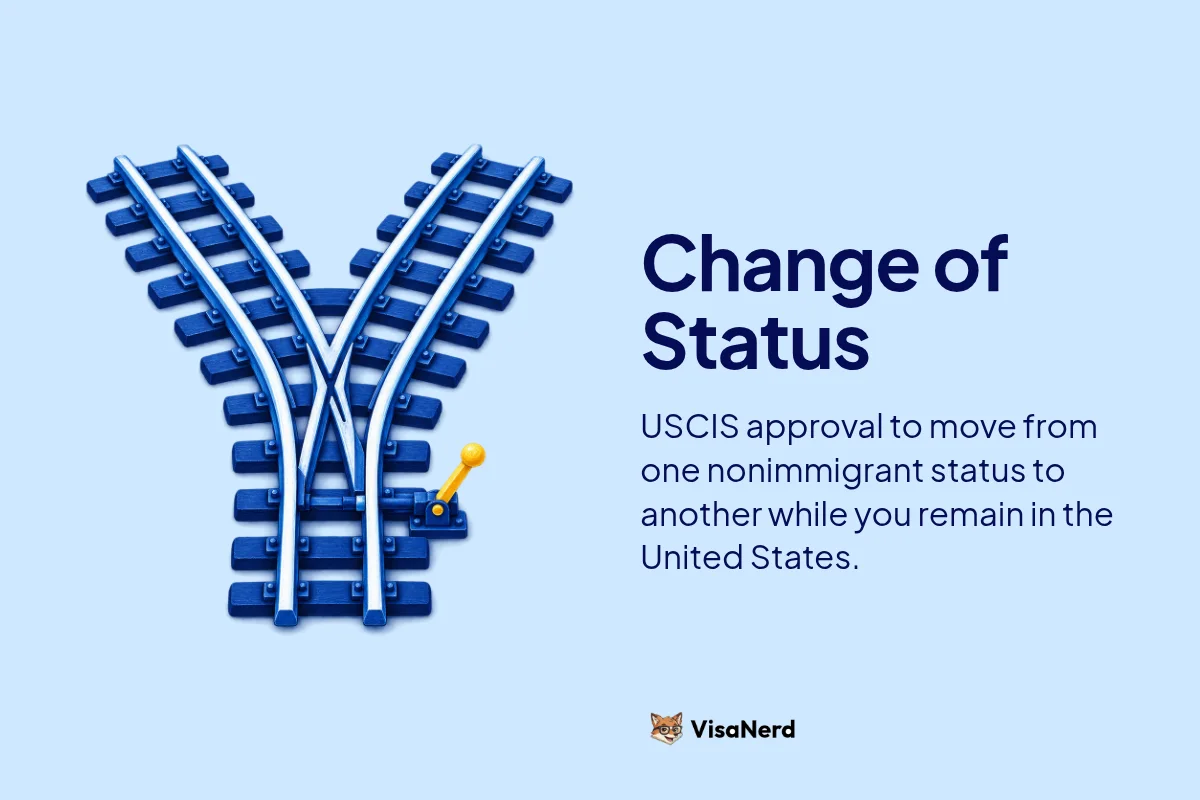
Table of Contents
What Is a Change of Status?
USCIS approval to move from one nonimmigrant status to another while you remain in the United States.
Key Takeaways
- You request a different nonimmigrant status from USCIS while in the US.
- J-1 participants subject to the Two-Year Rule face additional restrictions.
- A Program Extension is a different process.
- Decides
- USCIS
- Law
- INA § 248 (8 U.S.C. § 1258)
- Location
- Within the United States
- Filing
- Before your authorized stay expires
What Changes
To change the purpose of your stay, you or, in some cases, your employer files the appropriate request with USCIS before your authorized stay expires. In general, you must have been lawfully admitted, still hold valid status and have complied with its conditions.
USCIS says not to assume approval or change your activity before it approves the request. A change is discretionary, not automatic.
Source: USCIS: Change My Nonimmigrant Status · 8 U.S.C. § 1258 (INA § 248): Change of nonimmigrant classification
The J-1 Visa Restrictions
Under INA § 248(a)(3), a J-1 participant subject to the two-year requirement who has no waiver generally cannot change nonimmigrant status within the US. Except for graduate medical education or training, the statute allows an exception for A or G classification. Section 248(b) also excepts changes to T or U classification from these restrictions.
Graduate medical education or training has a separate restriction. USCIS says a change after graduate medical training requires a special waiver, apart from the T and U exceptions.
INA § 212(e) separately restricts immigrant visas, permanent residence and H or L visas until the home-country requirement is fulfilled or waived. See Waiver.
Source: 8 U.S.C. § 1258 (INA § 248): Change of nonimmigrant classification · 8 U.S.C. § 1182(e): INA § 212(e) · USCIS: Change My Nonimmigrant Status
Not a Program Extension
Your sponsor's Responsible Officer can extend your J-1 program within the permitted limits and issue a new DS-2019. That is not a move to another nonimmigrant classification.
Under current 8 CFR 214.2(j), a new program end date alone does not extend your lawful stay. Staying beyond your authorized admission period requires a separate extension-of-stay application to USCIS.
Source: J-1 Visa: Adjustments and Extensions · 8 CFR § 214.2(j): Exchange visitors · 8 U.S.C. § 1258 (INA § 248): Change of nonimmigrant classification
FAQs
Does a waiver guarantee my change of status?
No. A waiver addresses the two-year requirement. You still need to qualify for the requested status and obtain USCIS approval.
Source: 8 U.S.C. § 1258 (INA § 248): Change of nonimmigrant classification · USCIS: Change My Nonimmigrant Status
The Bottom Line
A change of status needs USCIS approval and eligibility under the J-1 Visa restrictions. It is not the same as extending your program or your stay.
Related Terms
- USCISU.S. Citizenship and Immigration Services, the agency that decides J-1 Visa stay extensions, status changes, waivers and J-2 work authorization.more
- Two-Year RuleSome J-1 participants must spend two years in their home country before getting an H or L visa or a green card.more
- WaiverA USCIS exemption from the J-1 Visa two-year home-country physical presence requirement under INA § 212(e).more
- Program ExtensionMaking a running J-1 program longer, possible only up to the maximum duration of your category.more
- Responsible OfficerThe State Department-approved official at your J-1 sponsor who oversees its exchange program and issues DS-2019 forms.more
- DS-2019The Certificate of Eligibility your J-1 sponsor issues. You need it to apply for your visa.more




Sources
- USCIS: Change My Nonimmigrant Status
- 8 U.S.C. § 1258 (INA § 248): Change of nonimmigrant classification
- 8 U.S.C. § 1182(e): INA § 212(e)
- J-1 Visa: Adjustments and Extensions
- 8 CFR § 214.2(j): Exchange visitors